.png)
"Il faut être patient... et surtout ne pas se décourager"
Je suis Ludovic Demierre. Je suis le Directeur des Ressources Humaines du Groupe VINCI. VINCI, c’est un groupe mondial qui fait à la fois de la construction, du service à l’énergie et des concessions dans le domaine des infrastructures. Nous sommes plus de 285 000 collaborateurs dans le monde entier, dans plus de 100 pays.
Comment la perception de la santé mentale a-t-elle évolué chez VINCI ?
La santé mentale, c’est un sujet qui est encore un peu tabou. À la fois tabou dans les entreprises, mais aussi tabou pour les collaborateurs. Ce sujet est parfois mal perçu parce qu’on confond santé mentale et maladie mentale. Pourtant, on sait que ce n’est pas le même sujet.
Nos collègues anglo-saxons ont travaillé depuis longtemps sur ce thème, et cela nous a beaucoup aidés à progresser. Tout comme la grande cause nationale 2025, en France, qui a ouvert le dialogue sur ce thème de la santé mentale dans nos entreprises.
Pourquoi la santé mentale est-elle un enjeu stratégique pour VINCI ?
C’est un sujet très important pour nous, chez VINCI, en lien avec la sécurité et la santé de nos collaborateurs. Quand on fait nos enquêtes sur les accidents graves ou les accidents mortels que nous avons encore malheureusement chez VINCI, on se rend compte que, dans au moins un cas sur deux, une des causes racines a une origine dans la santé mentale.
Donc c’est un enjeu de court terme, sur la santé et la sécurité des collaborateurs au quotidien. Et c’est aussi un enjeu de long terme, parce qu’une mauvaise santé mentale contribue à l’usure professionnelle prématurée de nos collaborateurs. Dans un monde où nous allons devoir travailler plus longtemps, la santé mentale est clé.
Quelles actions mettez-vous en place pour renforcer la prise en compte de la santé mentale chez VINCI ?
Nos entreprises, sur le terrain, ont mis en place de nombreuses actions. Cela va de la sensibilisation à la formation des managers, mais aussi à la formation de secouristes en santé mentale, en France et dans beaucoup de pays où ces actions existent déjà depuis de nombreuses années.
Par exemple, dans le secteur de la construction en France, nous déployons, dans certaines de nos sociétés, Holivia, qui est notre partenaire pour sensibiliser, former et accompagner nos collaborateurs dans le domaine de la santé mentale. C’est aussi avec Holivia que nous avons formé des secouristes en santé mentale, pour pouvoir répondre au plus près aux besoins de nos collaborateurs.
Quel impact ces actions ont-elles eu sur vos équipes et votre culture managériale ?
La difficulté, quand on met en place des actions sur la santé mentale, c’est de mesurer leur impact. Là où nous avons mis en place Holivia, nous disposons d’un tableau de bord, d’un baromètre, qui nous permet de mesurer la dynamique qui se met en place grâce aux actions menées.
Ce que je peux dire, c’est qu’il y a une dynamique vraiment positive qui se met en place, et je vous donne rendez-vous dans quelques semaines ou quelques mois pour vous en dire plus.
Comment vivez-vous la place croissante de la santé mentale dans les conversations RH et managériales chez VINCI ?
Quand on s’occupe de ressources humaines, on cherche avant tout à s’occuper de la santé, de la sécurité et du bien-être de ses collaborateurs.
Le sujet de la santé mentale pouvait paraître comme quelque chose de pas connecté à notre métier, qui devait être traité par d’autres, ou qui n’était même pas identifié comme faisant partie du champ des ressources humaines.
Pourtant, depuis qu’on s’en occupe, nous sommes tous maintenant convaincus que cela fait partie du métier des ressources humaines et que cela contribue globalement au bien-être de nos collaborateurs et à la performance de l’entreprise.
Je crois que nous avons été parmi les premières entreprises à vraiment nous en occuper et à mettre des moyens pour développer la prise en charge de ce sujet dans nos entreprises. Et nous en sommes particulièrement fiers.
Quel message souhaitez-vous passer à vos pairs ou aux dirigeants ?
Le premier message que je souhaite adresser, c’est que la santé mentale est un sujet qui reste délicat. Il faut donc l’aborder en fonction de sa culture, de la maturité de son organisation.
Pour cela, il ne faut pas hésiter à se former, à former ses managers et à se former soi-même au sujet. Cela permet de mieux comprendre de quoi on parle et de pouvoir s’engager aussi personnellement dans ce domaine.
Le deuxième message, c’est qu’il faut être patient. Le sujet de la santé mentale est parfois difficile à appréhender. Il faut prendre le temps de dialoguer, de travailler ce sujet au sein de l’entreprise, entre les managers, avec les collaborateurs. Donc prenez votre temps, faites-le avec votre style et, surtout, ne vous découragez pas.
Quel serait votre mot d’ordre pour faire avancer la santé mentale au travail ?
Au départ, dans l’entreprise, on n’était pas tous d’accord sur le sujet de la santé mentale. Aujourd’hui, je crois qu’on est tous prêts à travailler sur ce sujet collectivement. Donc mon mot d’ordre, c’est : ténacité.
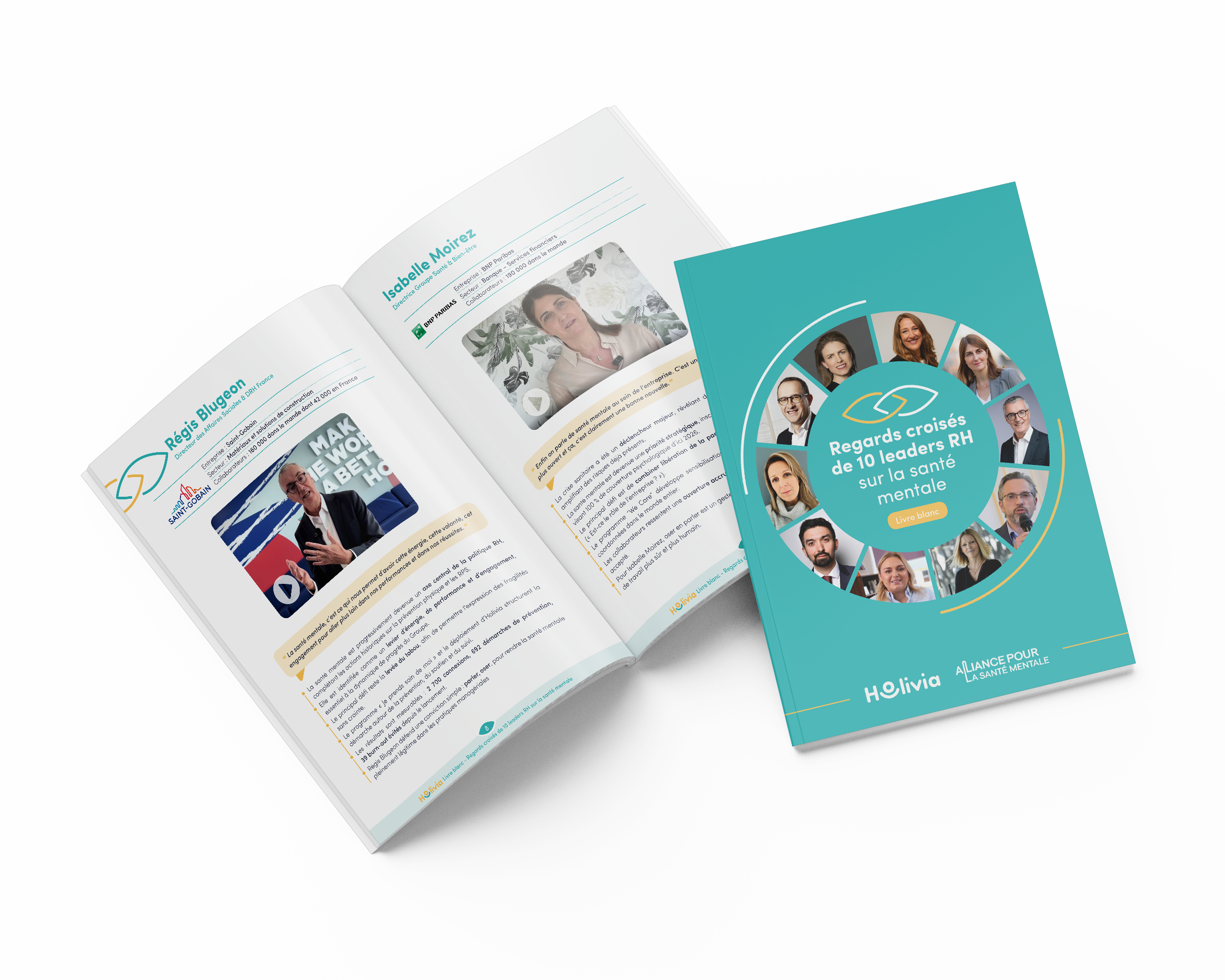
D’autres leaders RH ont partagé la transformation qu’ils portent dans leur entreprise. Découvrez les interviews menés en 2025, les dynamiques communes observées ainsi que nos recommandations d’actions dans notre dernier ouvrage : Regards croisés de 10 leaders RH sur la santé mentale.




.png)